

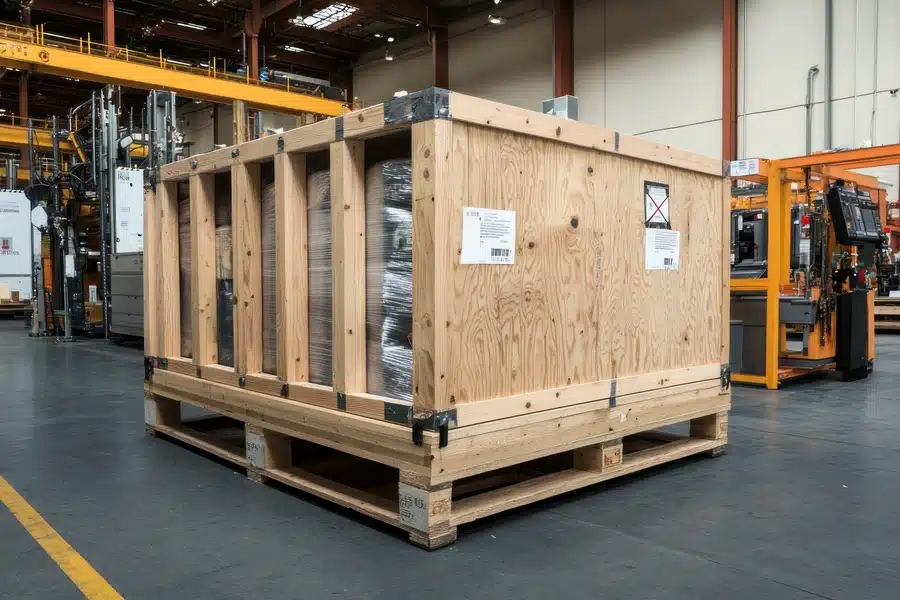
Moves go wrong in the parts that are forgotten. A missed plug, a flimsy crate, a centre-of-gravity nobody wrote down and that resulted in a tipped forklift truck. Packaging is a key insurance policy against all of these issues.
Done well, it turns fragile, oily, awkward machines into stable, shippable modules that survive forklifts, rain, potholes, and the occasional over-enthusiastically torqued strap. Here’s a practical, field-tested way to package for a full relocation – factory to factory, without any avoidable issues.
Start with a survey
Walk the route and the machines that need to be moved. Note weights, dimensions, lifting points, and the real centre of gravity (not the marketing drawing), photograph every face, nameplate, cable run, and guard before you touch a tool.
Record known faults, chipped coatings, leaks, so they don’t come back to haunt you as transit damage and you don’t blame your contracted movers. While you’re there, check access: door heights, slab capacities, ramps, mezzanines, tight turns. The survey dictates what you’ll build and use to move your machines.
Strip-down with reassembly in mind
Remove anything that sticks out, wobbles, or dislikes vibration: HMIs, servo drives, glass scales, tool magazines, sight glasses, antennas, handwheels, and any flimsy or protruding guards. Bag and label fasteners by sub-assembly (“Left guard – M8 x 25 – 8 pcs”), and tuck a reassembly card inside each bag with torque specs.
Colour-code multi-pin cables and hose pairs; cap every hydraulic/pneumatic port to keep grit out, or you could destroy a machine worth tens of thousands of pounds. If fluids are coming with you, drain to safe levels and use transit blanks. If not, drain completely and tag the machine DRY in large letters, to make re-oiling much easier.
Preserve surfaces & internals against time and weather
Bare ways, spindles, couplings and ground faces need protection. A thin film of rust preventative, VCI (volatile corrosion inhibitor) paper on mating surfaces, and – if ocean or long-term storage is involved – potentially even an inner barrier bag with desiccant.
For humid routes or sea air, go further: aluminium barrier foil, heat-sealed seams, a calculated desiccant load, and humidity indicator cards where you can check them through a viewing window. Don’t forget silica gel needs volume-based calculations; simply throwing in a few bags isn’t an effective plan.
Treat electronics extra carefully
Control cabinets, motion controllers, encoders, load cells and spare PCBs go in anti-static (ESD) packaging – pink foam for cushioning, static-shield bags for the Faraday effect, and rigid outer cartons.
Keep heavy items out of the same carton as delicate boards, and make sure that none of these items can move around in the boxes they’re placed in. Use shock and tilt indicators on crates, so rough handling has a witness and incidents can be traced; fit data loggers if the contract calls for them.
Build a base that forgives rough floors
Skids should be designed to take the beating so that the machine doesn’t have to. Use heavy timber or steel skids that are appropriately sized to the load and the forklift pockets you actually have. Spread the bearing area so a pallet truck on a dodgy ramp doesn’t punch through.
Block and brace to stop fore-aft and lateral slippage and tilts; screw blocks anti-split and triangulate where you can, if it seems to be necessary. Leave fork pockets or sling points clear, and stencil the COG on both sides. If the machine stays upright, add outriggers or a wider footprint so it won’t be at risk of tilting dangerously during sharper turns (but use slower driving speeds as a main precaution).
Crate for impact, weather, and human error
Think of the crate that you place your machines in as a small building: core elements consist of a base, frame, sheathing, and a roof. Sheath with boards or ply thick enough to resist snagging and point loads, and if there’s any chance of rain (there always is, especially over a longer time frame), add a pitched top or at least a drip edge and breathable vents.
For export, use heat-treated timber if using timber at all (ISPM-15) and stamp it – customs will care, even if nobody else does. Internally, keep metal off of other metal surfaces; use rubber or high-density foam isolators under feet and strap-paths. If the item is tall and slender, consider a skeleton frame plus shrink wrap rather than a full box – it’s both easier to secure and inspect if need be.
Lock the machine to the crate; don’t just set it inside
Through-bolts, steel straps to fixed eyes, or welded brackets – whatever you choose to go with, restraints must stop any bounce and sway. Ratchet straps are fine for non-delicate modules, but use edge protectors so webbing doesn’t cut into the machine or bend any panels, and tie them to the base, not to removable or otherwise delicate parts.
For more precise assets, isolate them with cushioned mounts and preload them so they can’t rattle. If you can move the item by hand inside the crate, bumps in the road will likely do a whole lot worse.
Moisture, dust, and the “two-skin” approach
For sensitive equipment, use two barriers: an inner sealed bag (desiccant and humidity card inside) and an outer weather skin (shrink wrap with vents or a lined ply shell). Cut inspection windows for the cards so you don’t have to unseal the inner bag to check them, and avoid fully airtight outer wraps unless you provide venting; trapped moisture plus sun or other heat sources will lead to condensation, which is an absolute no-no.
Packaging in these contexts isn’t decoration. It should be designed as engineered protection that aims to turn complex, delicate, or downright awkward machines into units that can be safely lifted, stacked, strapped and shipped.
If you survey thoroughly and understand what each machine needs in order to be properly protected, prepare the machine pre-move, build a base that forgives rough handling, and label everything adequately, you’ll have a high chance that you arrive at the other end with a machine that starts work, not a refurb project that brings a whole world of issues of itself.