

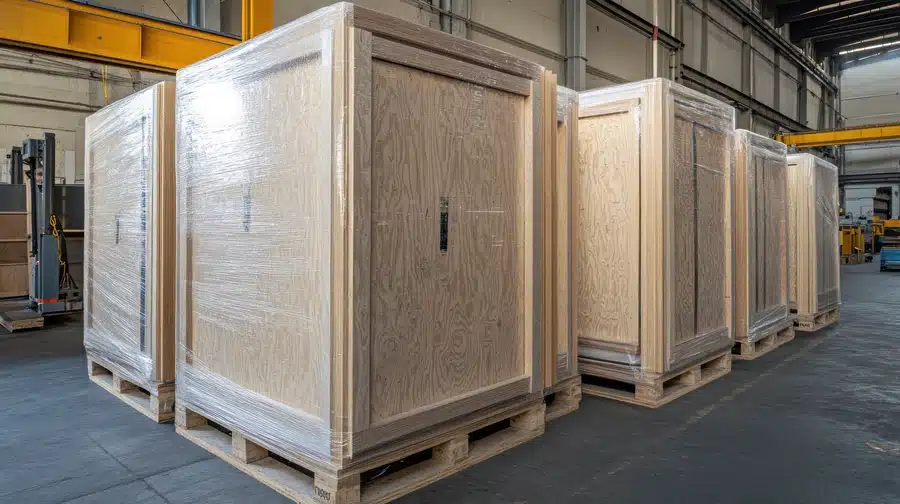
When a machine is shipped overseas, it can be exposed to harsh and unpredictable conditions. Although it may leave the factory floor in perfect condition, it can still arrive at a foreign port pitted with rust, knocked out of alignment, or be held up in customs over a single non-compliant timber stamp.
An ocean voyage exposes cargo to salt-laden humid air, repeated condensation cycles inside a sealed steel box, and constant vibration and shock from loading, ocean swell, and inland transport, for four to eight weeks or more.
Standard packing was never built to survive this challenge. AIS VIG Industrial’s export packing is engineered specifically for long-haul international freight and designed to defend against the two major causes of damage during overseas machine transport.
The Hidden Risks of Long-Haul Machinery Transit
Most damage to exported machinery is caused by two persistent forces working on the cargo for weeks at a time.
Moisture. A shipping container is effectively a sealed metal box that heats up in the sun and cools overnight, day after day, for the entire voyage. That temperature swing causes condensation to form on the container’s ceiling and walls. This phenomenon, known as “container rain,” is when droplets fall directly onto the cargo below. Combine that with humid air, salt-laden sea air at port, and a long voyage, and the conditions are ideal for corrosion on exposed metal, moisture ingress into electrical cabinets and PCBs, and for bearings or moving parts to seize.
Motion. The second risk is mechanical. Machinery is subject to shocks and shifting throughout the journey. Causes include crane lifts and loading, constant low-level vibration from the ship’s engines, ocean swell, and movement during the road or rail legs at either end of the journey.
Without the right internal restraint and load distribution, that motion shows up as misalignment of precision components, fractured castings, and damaged shafts or bearings. These faults may not become apparent until the machine is commissioned in its new location.
To counter these risks, AIS VIG Industrial builds engineering controls into every export crate to neutralise them before they reach the cargo.
Seaworthy Crating, Built for the Journey
Generic packing treats every machine the same; export crating shouldn’t. AIS VIG Industrial engineers bespoke timber and plywood crates for each project, with skids built to each machine’s exact dimensions, weight, and centre of gravity.
Inside the crate, internal bolt-down mounting, cradles, chocking, and bracing are employed to keep the machine stable and prevent movement during the voyage. Sensitive components receive shock and vibration cushioning, including foam padding and anti-vibration mounts, while precision parts are isolated from constant low-level shake.
The same care is extended to the outside of the crate. Clear case markings show lifting points, centre-of-gravity marks, fork pockets, and sling positions, alongside standard handling symbols and weight. These markings ensure every handler along the route understands how to move the crate correctly. Optional shock and tilt indicators can also be fitted, so any mishandling in transit is evidenced on arrival, rather than discovered weeks later as an unexplained fault.
Anti-Corrosion and Moisture Protection
We build a sealed barrier around machinery using aluminium or MIL-spec barrier foil to form a heat-sealed enclosure. Vacuum sealing or shrink wrapping then draws out the air, physically removing the source of moisture that would otherwise condense on the metal inside the crate.
We also employ two further layers of defence that work in tandem:
- Volatile corrosion inhibitors (VCI), in the form of films, papers, or emitters, release a protective vapour onto the bare metal surfaces of machinery, forming an invisible layer that blocks rust.
- Desiccants (typically silica gel) take a different approach: they absorb residual moisture from the sealed air. The required quantity is calculated based on the enclosed volume, dialling in humidity below the corrosion threshold for the entire voyage.
VCI actively protects the machinery’s metal surface, while the desiccant works on the surrounding air. This anti-corrosion packing system creates a controlled, dry microclimate around the asset, regardless of the ocean and weather conditions outside the crate.
ISPM15 Compliance: Clearing Customs Without Delay
Non-compliant packaging is another threat to a smooth overseas crossing. A machine can be stopped at the border if its wooden packaging is non-compliant, leading to costly, unplanned downtime.
ISPM15 (International Standards for Phytosanitary Measures No. 15) regulates solid wood packaging material used in international trade, such as crates, pallets, and dunnage. This international standard, set by the International Plant Protection Convention (IPPC), is designed to prevent the spread of timber pests and diseases that can hide within untreated wood packaging and travel between countries.
Our timber packaging is heat-treated and marked in strict accordance with ISPM15 standards. It carries the official IPPC mark, which features the wheat-ear logo, a two-letter country code, a unique number assigned to the producer or treatment provider, and a treatment code indicating which method was used. Most commonly, the method code is HT for heat treatment or MB for methyl bromide fumigation.
The heat-treatment process involves heating timber to a minimum core temperature of 56°C for at least 30 minutes, eliminating pests without chemical residue. It’s worth noting that engineered wood products such as plywood, OSB, and MDF are manufactured under conditions that generally exempt them from ISPM15 marking altogether.
Cargos, including non-compliant wood, can be refused entry, fumigated on arrival, returned, or destroyed at the importer’s cost, delaying the shipment and the wider project. Compliant timber, correctly marked, is what keeps a shipment moving smoothly through customs instead of sitting in a warehouse.
Container Loading and Global Logistics
Effective, compliant packing only pays off if the cargo is loaded and secured correctly inside the container or vessel. AIS VIG Industrial’s teams handle professional container loading, load securing, lashing, chocking, and bracing. These practices are conducted in line with recognised cargo-securing practices, including the CTU Code (Code of Practice for Packing of Cargo Transport Units), the internationally recognised reference for securing freight inside containers.
Not every machine fits inside a standard box. For out-of-gauge or oversized equipment, AIS VIG Industrial arranges flat racks, open-top containers, or break bulk shipping as needed, matching the loading method to the cargo rather than the other way round.
This service sits within our wider international machinery relocation and global logistics offer. AIS VIG Industrial has the expertise and capabilities to coordinate your machine move from start to finish, handling decommissioning, packing, freight, documentation, delivery, and machinery installation. Working with a single, accountable partner minimises the coordination gaps and handover issues that often arise when dealing with multiple contractors.
For projects requiring a staging point before the next leg of an international move, AIS VIG Industrial’s machinery storage solutions are the perfect pairing, keeping packed assets secure between collection and shipment.
Why VIG?
AIS VIG Industrial has been providing export packing for machinery moves for five decades, building invaluable hands-on experience in managing the risks associated with overseas machine moves. Packing is handled in-house by teams who understand both the crate’s engineering and the realities of ocean freight, rather than being outsourced to a generic packaging contractor.
That experience operates across the UK, Europe, and beyond into global industrial logistics, backed by insurance cover suited to high-value capital equipment in transit.
Shipping a Machine Overseas?
We can provide an expert packing assessment before your machine ships. Send us the specs, dimensions, and destination, and we will provide a tailored export packing quote built around your specific shipment.